Every September, the same question starts making the rounds: what are the almanacs saying about the winter ahead? Property managers and homeowners across the DMV read the headlines, compare the maps and try to make sense of what it might mean for their properties.
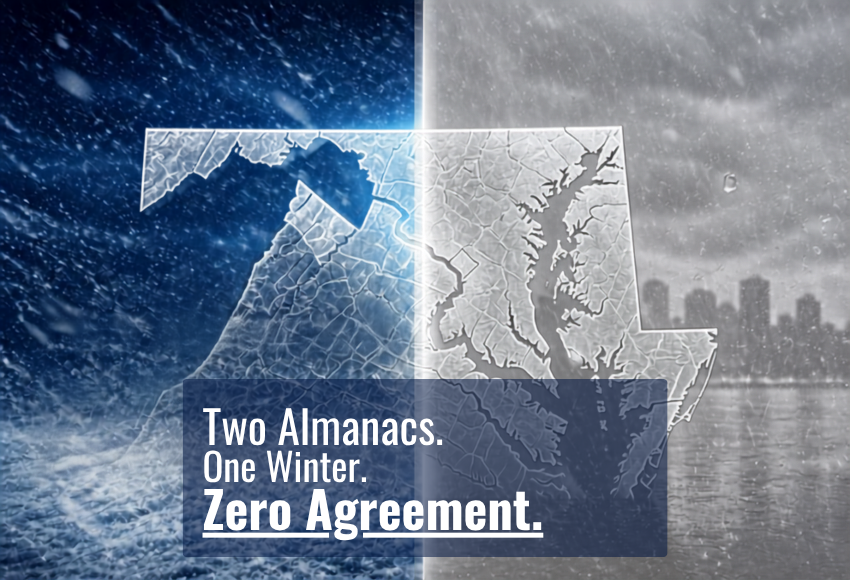
This year, the answer is a little messy: the two best-known almanac forecasts are not saying the same thing.
The Farmers’ Almanac has placed much of the Mid-Atlantic in a zone it’s calling “coastal storms, snow, sleet, and mix.” The Old Farmer’s Almanac, a separate publication despite the nearly identical name, has Washington, DC, Montgomery County and much of Maryland and Northern Virginia sitting inside a “cold, snowy” zone on its national map.
Same region. Same season. Two different headlines.
And it gets more complicated from there.
One Almanac, Two Different Answers
The Old Farmer’s Almanac national map tells one story: cold and snowy. Its more detailed Atlantic Corridor forecast, the one that actually covers DC, Maryland and Northern Virginia, is more measured. It calls for above-normal temperatures, below-normal precipitation and slightly below-normal snowfall for the season overall.
So which is it? Both, in a sense. The region can see multiple cold, snowy stretches – the Almanac points to early-to-mid December, early-to-mid January and both ends of February as its coldest windows, with snow chances in late November, January and February, and again in late March – without the winter as a whole landing above normal. A season can deliver sharp, disruptive stretches and still average out to “mild” on paper.
That’s not a contradiction. It’s just how seasonal outlooks work.
Why This Doesn’t Change How We Prepare
Here’s the thing about almanac forecasts, farmer folklore and even the more sophisticated seasonal outlooks from NOAA: they’re interesting. They’re fun to read in September. They are not something a commercial property, federal facility or residential community should be building a winter program around.
A property that staffs, stocks and stages based on a “mild winter” headline is exposed the moment that forecast is wrong. Long-range outlooks – whether from an almanac or a more rigorous seasonal model – are directionally interesting at best. They can’t tell you whether the storm that hits your property in February is two inches of powder or something far messier.
It is also worth putting the almanac accuracy claims in perspective. Both publications promote accuracy rates around 80%. Independent analysis has been less generous: a widely cited University of Illinois study comparing the Old Farmer’s Almanac’s monthly temperature and precipitation forecasts with actual recorded weather found accuracy closer to 51–52%, essentially a coin flip. That difference is why these outlooks are better treated as interesting September reading than as the foundation for an operating plan.
We don’t have to look far for a local example. Last year at this time, the Farmers’ Almanac was calling for a milder, higher-than-average-temperature winter across the Mid-Atlantic. What the DMV actually got was one of the most demanding winters we’d seen in years – back-to-back storms, repeated freeze-thaw cycles and sleet transitions mid-event. A property that planned around “milder than average” would have been caught flat-footed more than once.
That is the real problem with planning winter operations around seasonal headlines.
The Real Challenge in the DMV Isn’t Snow. It’s Uncertainty.
The Farmers’ Almanac talks about coastal storms, snow, sleet and mixed precipitation. The Old Farmer’s Almanac suggests periods of cold and snow. Whether either prediction proves accurate isn’t really the point.
The challenge for property managers in Maryland, Washington, DC and Northern Virginia is that winter here rarely arrives in a clean, predictable package:
- A six-inch snowfall is straightforward.
- Rain followed by a flash freeze isn’t.
- Freezing rain during a morning commute isn’t.
- A storm that starts as snow, changes to sleet, then refreezes overnight isn’t.
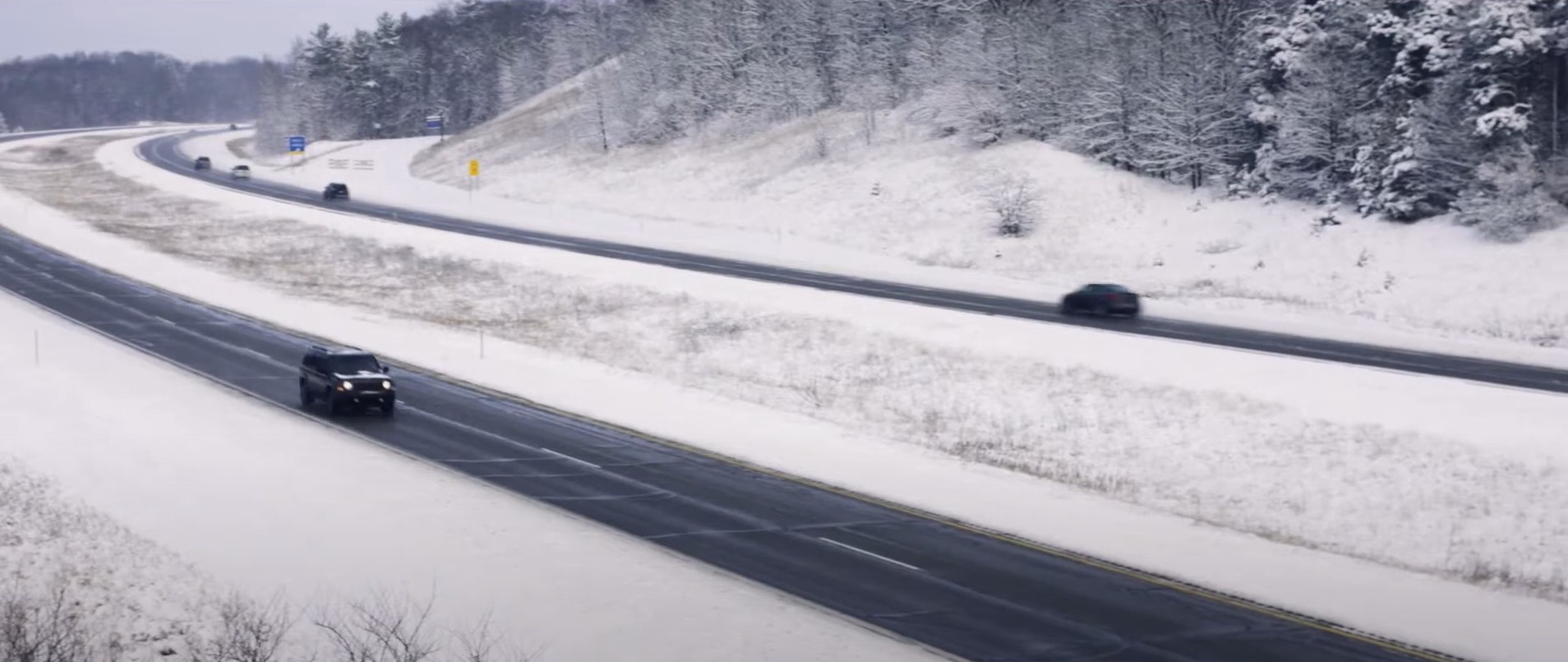
Those are often the events that demand the most attention, precisely because they do not fit neatly into a forecast headline. A property can go into a storm expecting “a couple inches of snow” and come out the other side with a sheet of ice across every entrance and walkway. The DMV sits close enough to the coast to pull in Atlantic moisture and far enough inland to catch real cold air behind it. When those two meet in the same storm, precipitation type can shift more than once before the event is over. That is why a plan built only around “how much snow” misses half the picture.
Forecasts Are Interesting. Flexibility Matters More.
Every September, people want to know if the upcoming winter will be snowy. That’s understandable.
But when it comes to commercial winter operations, the better question is whether your snow and ice management program is prepared for uncertainty – for the storm that doesn’t behave the way the forecast said it would.
Because the difference between a successful winter and a frustrating one rarely comes down to whether an almanac was right.
It comes down to how well a property adapts when conditions don’t go according to plan.
The RASEVIC Route
Every year, someone asks what the almanacs are saying about the upcoming winter. It’s a fair question – just not the one that determines how a property performs in January.
If you are reviewing your winter plan now, make sure it accounts for the full range of DMV conditions, not just one forecast’s best guess. That means snow, sleet, freezing rain and the messy events that bring all three into the same day.
To talk through what that should look like for your property in Maryland, Washington, DC or Northern Virginia, book a consultation, fill out our contact form, email orders@rasevic.com or call 301-986-6900.
Sources
The Farmers’ Almanac, 2026-2027 Winter Weather Forecast
The Old Farmer’s Almanac, 2026-2027 Winter Outlook